Showing posts with label Historical Fiction. Show all posts

Friday, 18 February 2011

The Chapel at the Edge of the World

Synopsis: Emilio and Rosa are childhood sweethearts, engaged to be married. But it is 1942 and the war has taken Emilio far from Italy, to a tiny Orkney island where he is a POW. Rosa must wait for him to return and help her mother run the family hotel on the shores of Lake Como, in Italy. Feeling increasingly frustrated with his situation, Emilio is inspired by the idea of building a chapel on the barren island. The prisoners band together to create an extraordinary building out of little more than salvaged odds and ends and homemade paints. Whilst Emilio's chapel will remain long after the POW camp has been left to the sheep, will his love for Rosa survive the hardships of war and separation? For Rosa is no longer the girl that he left behind. She is being drawn further into the Italian resistance movement and closer to danger, as friendships and allegiances are ever complicated by the war. Human perseverance and resilience are at the heart of this strong debut and the small Italian chapel remains, as it does in reality on the island of Lamb's Holm, as a symbol of these qualities.

Review: This was a bit of a slow burner, in fact I'm not sure it ever caught fire. It took me quite a long time to get the characters fixed in my mind and I don't think I ever understood them completely but then I think that was a reflection of the austere times they were living in, they were quite secretive and introspective. Emilio is sent abroad to Africa to fight for Mussolini during WWII and his fiancé - Rosa - is left behind in Lake Como. Emilio and his fellow soldiers are soon captured and are due to be transported as POW's to India but fearing another hot climate, along with it's attendant flies and disease, he is able to wangle a favour from a British corporal (Emilio is a painter and becomes popular among his captors by painting little portraits of their loved one's from photo's) and secures a place on a ship bound for the Orkney Islands, Scotland (to work on the Churchill Barriers.) Struggling to cope with heat is one thing but the alternative proves to be, if anything, more oppressive. When they land at Orkney they are overwhelmed by the sheer desolation of the place, it's the colour of concrete and the wind, which blows fiercely every day, is like a wall that hits you in the face every time you turn a corner. The sky and sea are a mutinous grey, the temperatures are freezing and the landscape is barren and flat as no trees can survive. It's a million miles away from the beauty and climate of Lake Como.

Rosa meanwhile is at home, both living with and helping out her mother at their hotel. She is a little confused regarding her feelings for Emilio, she thinks about his return and their marriage and feels suffocated by it. Italy is now under German occupation and everyone's movements are watched. The hotel is a favourite haunt of the German officers so caution is needed. Rosa finds a job at a little print shop and there meets a childhood friend of hers and Emilio's - Pietro - with whom she becomes incredibly close and it's through this friendship that she learns of, and becomes involved with, resistance work. Her little errands for the resistance become increasingly risky especially as there is a German officer at the hotel who has taken a shine to her and who always seems to be watching.

Rosa's letters to Emilio become more and more general and less and less personal, letters about the hotel guests and the local flora and fauna. Emilio is depressed and demoralized but a small ray of light occurs when the new CO of the camp announces that they can convert an old Nissan hut into a chapel. Nobody is particularly excited by this but Emilio is inspired when he reads a newspaper article about a girl who made a wedding dress out of seaweed and custard powder. His enthusiasm soon rubs off on the others and they begin work on the transformation. Not only will it give them somewhere to worship it will give them something to do as they wait to be transported back home. By this time they are no longer prisoners in the official sense but, Germany still has occupation of Italy, and there is no knowing how long it will be before they return home. Hopes are raised and dashed continually.

It was a good read, nothing particularly enthralling but quietly compelling in it's own way. I didn't feel there was enough descriptions of how the POW's built the exquisite little chapel, when you look at the pictures of the real chapel it's just breathtaking. That prisoners could create such a beautiful work of art out of nothing but scraps and salvage is amazing and should have been described in more detail. Also I felt some of the sting went out of the tale by having the aged Rosa and Emilio talking at the beginning of the book ... obviously you knew that nothing particularly catastrophic was going to befall them. The book cover however is beautiful, probably my favourite so far.

Friday, 17 December 2010

The Blue Flower

Synopsis: Penelope Fitzgerald's final masterpiece. Set in Germany at the very end of the eighteenth century, The Blue Flower is the story of the brilliant Fritz von Hardenberg, a graduate of the Universities of Jena, Leipzig and Wittenberg, learned in Dialectics and Mathematics, who later became the great romantic poet and philosopher Novalis. The passionate and idealistic Fritz needs his father's permission to announce his engagement to his 'heart's heart', his 'true Philosophy', twelve-year-old Sophie von Kuhn. It is a betrothal which amuses, astounds and disturbs his family and friends. How can it be so? One of the most admired of all Penelope Fitzgerald's books, The Blue Flower was chosen as Book of the Year more than any other in 1995. Her final book, it confirmed her reputation as one of the finest novelists of the century.

Review: This is a book that came highly recommended by Susan Hill (in her words 'it's a novel of genius') in her book Howards End is on the Landing, I'd never heard of it before. When I next went to the library, there it was winking at me from the shelf and so, of course, I grabbed it gratefully.

It's a fictionalised account of the life of Friedrich von Hardenburg born in 1772, otherwise known as the German author, poet and philosopher Novalis, and known in this narrative as Fritz. In particular the book focuses on the relationship between Fritz and his true love Sophie von Kuhn. It's a pretty tall task for the reader to quite grasp the intensity of his love given that Sophie is only twelve when Fritz meets and proposes marriage to her. And indeed she doesn't seem to be particularly beautiful or intelligent (which is what Fritz's brother tries to tell him .. until he falls in love with her himself after five minutes in her company,) she's a bit silly and fanciful like most twelve year olds but then, love is often irrational and inappropriate.

Fritz himself is a very accomplished student and aspires to be a poet but is ultimately destined, as the eldest son, to follow in his fathers footsteps as the Salt Mine Directorate. His father sends him to study business with Coelestin Just and here he furthers his acquaintance with Karoline Just who is niece and housekeeper to her Uncle Coelestin. Karoline is pretty, kind, intelligent and (rather like Agnes Wickfield in David Copperfield) far more suitable as a match for Fritz but he see's her only as a dear friend, his heart is not moved by her.

It's Coelestin that first introduces Fritz to the Rockenthiel family and ultimately Sophie, and within a quarter or an hour of being in her company, Fritz's heart is irrecoverably lost. Before long he has proposed to her and sets out to find out as much as he can about her. He asks Sophie about her favourite food, how her studies are going, whether she likes music and in an effort to philosophise with her talks about transmigration and asks if she would like to be born again 'yes' says Sophie 'if I could have fair hair.' Fritz can only spend a limited time with Sophie but obtains permission to write, but when he receives a letter back from her she says that, although she loves to receive his letters, she herself can write no more. When Fritz enquires of her stepfather why this is so, he answers 'My dear Hardenburg, she must write no more because she scarcely knows how. Send for her schoolmaster and enquire of him!' however Sophie does continue to write him little epistles and he has to content himself with the flimsy information they contain and his occasional visits to the Rockenthiels.

However he is smitten, she is his 'wisdom' his 'true philosophy,' 'spirit guide' and 'heart's heart', and he sets about convincing his father to agree to the match. Again, it has to be said that his father is less than happy about it but he reluctantly consents. Sophie is now fourteen and ailing, she has tuberculosis. Still she makes the journey to Weissenfels to meet with Fritz and his family at their formal engagement party. She has to be carried in, she is pale but still eager and as high pitched as ever, she cannot dance or walk about and so Fritz brings each of his friends and relations forward to meet and congratulate her. But Sophie's health is deteriorating, she has to undergo several painful operations without anaesthetic and sinks further and further every day. Poor Fritz who, for the most part, is unable to be with his love, and doesn't know how to help her when he is, frets and his father is so affected by his visit to the ailing Sophie that he sobbingly declares that he will give her the ancestral home. It's at this point of the story that the reader is able to see more into Sophie's heart and mind and although she never really becomes any different, you do begin to love her yourself .. perhaps because of her desperate plight.

Written very much as a novel would have been written in the eighteenth century and very witty and warm despite it's tragic outcome. The book is full of interesting characters, both Fritz's and Sophie's family are all so well depicted especially Sophie's incredibly kind and caring older sister Friederike (or 'the Mandelsloh' as she's called,) who is also her close companion and nurse, and Fritz's lovely sister Sidonie and brother Erasmus.


click here to continue review - possible spoilers


It's very affecting, to read the afterword and to see that none of the characters actually lived very long. After Sophie's death, Fritz eventually married Julie von Charpentier and said in a letter to a friend 'an interesting life appears to await me .. still, I would rather be dead'. Fritz died in 1801 aged 29.

Susan Hill is still fretting about the fact that this did not win a major prize when it was published, she says 'I was a judge for a major prize the year The Blue Flower was entered and I have never tried so hard to convince others of anything as I did that this one was a rare, a great, novel whose like we might none of us see again.'

Saturday, 6 November 2010

Mr Rosenblum's List

Synopsis: List item 2: Never speak German on the upper decks of London buses. Jack Rosenblum is five foot three and a half inches of sheer tenacity. He's writing a list so he can become a Very English Gentleman. List item 41: An Englishman buys his marmalade from Fortnum and Mason. It's 1952, and despite his best efforts, his bid to blend in is fraught with unexpected hurdles - including his wife. Sadie doesn't want to forget where they came from or the family they've lost. And she shows no interest in getting a purple rinse. List item 112: An Englishman keeps his head in a crisis, even when he's risking everything. Jack leads a reluctant Sadie deep into the English countryside in pursuit of a dream. Here, in a land of woolly pigs, bluebells and jitterbug cider, they embark on an impossible task.

Review: A very enjoyable read and a great mixture of comedy and tragedy. I really, really took to Jack Rosenblum, he infuriated the life out of me and I couldn't believe what he was willing to risk in order to become the perfect (in his eyes) English gentleman but he was so well intentioned and naive that I couldn't dislike him. Likewise poor Sadie who never quite settles in her adopted home and misses her family terribly to the point of seeing visions and trying to re-create the scents of her mothers kitchen by marathon baking.

They're both at times extremely irritating, Jack is stubborn and obssessive and Sadie is resentful and unsupportive but there's something undeniably likeable about the pair of them. Jack is determined to become a very English Gentleman, he's written a list on the subject, and so far he's done well. He has set up his own very successful carpet business, he reads The Times, buys his suits from Savile Row and knows how to adjust his hat to the correct angle. The one thing he hasn't yet managed to do is become a member of an English golf course, however much money he makes, or whoever nominates him, his requests are always refused.

Daunted but undeterred Jack decides that he will build his own golf course in the grounds of his new house in Dorsetshire and have a grand opening on Coronation Day. Sadie finds that this new home deep in the countryside reminds her even more of her native Germany and she begins making a list of her own, a list of things she must remember in order to keep the past alive.

I loved the description of the Baumtorte which is a sort of remembrance cake, made by ladling the batter into the tin one layer at a time and grilling it before adding the next layer so that your finished cake resembles the rings of a tree, each layer representing the memory of a loved one or special occasion. Sadie makes a spectacular version of this, several feet high, in order to remember her loved ones but all this reminiscing is making her sadder and more isolated. Jack is so obsessed by his golf course that he doesn't notice just how lonely Sadie has become. He has worries of his own, for one thing getting the golf course ready in time (he has no experience, he's never even played golf and the terrain is all wrong.)

I loved his unpretentious newsy letters to American golfing legend Bobby Jones who designed the course at Augusta, despite never hearing back from him he writes weekly telling him about his progress or lack of it, and all in the wild hope that Bobby will impart some of his knowledge and perhaps even be there for the opening. It's a story where you long for a happy outcome. A gentle read, both funny and sad. If you enjoyed 'The Guersey Literary Potato Peel Pie Society' then you'll enjoy this.

Sunday, 10 October 2010

The Wives of Henry Oades

Synopsis: In 1890, Henry Oades decided to undertake the arduous sea voyage from England to New Zealand in order to further his family's fortunes. Here they settled on the lush but wild coast -- although it wasn't long before disaster struck in the most unexpected of ways. A local Maori tribe, incensed at their treatment at the hands of the settlers, kidnapped Mrs Oades and her four children, and vanished into the rugged hills surrounding the town. Henry searched ceaselessly for his family, but two grief-stricken years later was forced to conclude that they must be dead. In despair he shipped out to San Francisco to start over, eventually falling in love with and marrying a young widow. In the meantime, Margaret Oades and her children were leading a miserable existence, enslaved to the local tribe. When they contracted smallpox they were cast out and, ill and footsore, made their way back to town, five years after they were presumed dead. Discovering that Henry was now half a world away, they were determined to rejoin him. So months later they arrived on his doorstep in America and Henry Oades discovered that he had two wives and many dilemmas ! This is a darkly comic but moving historical fiction debut about love and family, based on a controversial court case from the early 1900s.

Review: I Liked this one, it has the sort of absurd humour that appeals to me. Immensely readable it tells the story of Henry Oades, who is seeking his fortune (and that of his wife Margaret and four children) in New Zealand in 1890. I believe the tale is based on a true story but Johanna Moran has given it flesh and bones. When Henry returns from work one evening he finds his home a smouldering wreck and the unrecognisable body of a woman amongst the ashes. he searches high and low for his family but cannot find them or news of them. Eventually, believing them to be dead, he sails to San Francisco where he eventually meets, falls in love and marries Nancy.

The reader knows all along that his first wife and children (all except one) are still alive, they have been captured and imprisoned by a local Maori tribe (with the body back at the homestead being that of a visiting friend) and you know it's only a matter of time before they all meet up (the title is a bit of a giveaway in that respect.)

'A pretty girl opened the door and eyed them up and down suspiciously. 'Forgive us for startling you' Margaret said 'Is this the home of Mr Henry Oades?.' The girl poked at her unruly hair 'who wants to know?' The insolent lass could use a good caning. 'We are Mrs Henry Oades and children, we're not expected.' The girl scowled, cocking her head as if she hadn't heard right. 'You're his mother?' 'I'm his wife miss, if it's any concern of yours'. The loony thing clapped hands to ears and closed her eyes. With an audible amen her hands dropped to her sides, wedding band gaudy new, winking with sunlight. 'I'm sorry, but I am Henry Oades wife now.'

Again it's a book that makes you laugh a lot but you also care about the characters .. Margaret in particular. It's a situation nobody would want to find themselves in, it's humiliating and degrading but Margaret is made of stern stuff and she's determined to make it work. That's not to say that Nancy is unlikeable, both women try and work things out so that they can all live in peace together but of course it's not as easy as that. They never descend into Krystal/Alexis catfighting as you might expect, there's a mutual respect and understanding of each other's position but they both harbour regrets and resentments as would be only natural. Watching them cope with each other and the situation they find themselves in is fascinating.A great story told with warmth and humour, I couldn't put it down.

Labyrinth (Audiobook)

Synopsis: When Dr Alice Tanner discovers two skeletons during an archaeological dig in southern France, she unearths a link with a horrific and brutal past. But it's not just the sight of the shattered bones that makes her uneasy; there's an overwhelming sense of evil in the tomb that Alice finds hard to shake off, even in the bright French sunshine. Puzzled by the words carved inside the chamber, Alice has an uneasy feeling that she has disturbed something which was meant to remain hidden...Eight hundred years ago, on the night before a brutal civil war ripped apart Languedoc, a book was entrusted to Alais, a young herbalist and healer. Although she cannot understand the symbols and diagrams the book contains, Alais knows her destiny lies in protecting their secret, at all costs. Skilfully blending the lives of two women divided by centuries but united by a common destiny, LABYRINTH is a powerful story steeped in the atmosphere and history of southern France.

Review: I didn't really enjoy this story, I practically gave up after listening to the first two sides, it seemed long and convulted and a bit clunky. I found I wasn't really interested in the modern day story of Alice but did get more intrigued by Alais's tale and that kept me listening. Nearly all the revelations were second guessed by me which means they must have been pretty obvious to begin with. The story didn't seem to gel or connect .. there was no 'skilful blending' ... and incredulity was stretched too far. Some stories have you suspending disbelief willingly .. I'm happy to imagine a hobbit in a hole or envisage an orangutan librarian but this was more of the 'you're having me on .. right?' sort. If I had had to read it instead of listen to it, it would definitely have been abandoned, lifes too short to turn that many pages of uninteresting, laboured prose. Perhaps I'm being harsh, it has a heavyweight reputation but it just didn't entertain me at all.

Wednesday, 28 July 2010

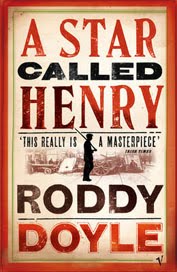
A Star Called Henry (Audiobook)

Synopsis: Born in the Dublin slums of 1901, his father a one-legged whorehouse bouncer and settler of scores, Henry Smart has to grow up fast. By the time he can walk he's out robbing and begging, often cold and always hungry, but a prince of the streets. By Easter Monday, 1916, he's fourteen years old and already six-foot-two, a soldier in the Irish Citizen Army. A year later he's ready to die for Ireland again, a rebel, a Fenian and a killer. With his father's wooden leg as his weapon, Henry becomes a Republican legend - one of Michael Collins' boys, a cop killer, an assassin on a stolen bike.

Review: 'My mother looked up at the stars. There were plenty of them up there. She lifted her hand. It swayed as she chose one. Her finger pointed. There's my little Henry up there. Look. I looked, her other little Henry sitting beside her on the step. I looked up and hated him. She held me but she looked up at her twinkling boy. Poor me beside her, pale and red-eyed, held together by rashes and sores. A stomach crying to be filled, bare feet aching like an old, old man's. Me, a shocking substitute for the little Henry who'd been too good for this world, the Henry God had wanted for himself. Poor me.'

This is an account of The Easter Rising and the subsequent War of Independence as told by Dubliner Henry Smart. The writing is brutal and shocking but also at times poetic and darkly humorous. It's not an easy read, although having Roddy narrate it brought a real authenticity to the story. It's totally unflinching and intense with, as you would expect given the subject matter, copious amounts of violence. The language is explicit and colourful and so is the graphic content but somehow Roddy threads the story with so much wit and absurdity that it doesn't feel as bleak and savage as it otherwise might and it is studded with absolute gems of characters like Miss O'Shea and Granny Nash. Also he writes so evocatively that you feel like you're there experiencing it first hand, which is fairly disturbing as, on the whole, they're not situations you'd like to find yourself in. Being one of the evil English it did have me wincing a bit and some of the depictions of violence were hard to swallow but all in all it's an incredibly accomplished piece of writing. It has the ability to shock you to your very core and make you laugh all in the same paragraph. I just loved the ongoing piece of business involving his fathers wooden leg .. genius.

I'd quite like to find out what happens to Henry Smart and so I probably will seek out the sequels at some point.

Saturday, 19 June 2010

Wolf Hall (Audiobook)

Synopsis: Tudor England. Henry VIII is on the throne, but has no heir. Cardinal Wolsey is charged with securing his divorce. Into this atmosphere of distrust comes Thomas Cromwell - a man as ruthlessly ambitious in his wider politics as he is for himself. His reforming agenda is carried out in the grip of a self-interested parliament and a king who fluctuates between romantic passions and murderous rages.

Review: Bliss! I loved every minute of it. A fascinating fictionalised account of the life of Thomas Cromwell, from his humble beginnings living in Putney as a blacksmith's son, to his position as Henry VIII's favourite right hand man. We join the story as Thomas is preparing to run away from his drunken and abusive father. He recounts the details of his fathers latest sadistic attack, and contrary to my preconceived ideas, it wasn't long before I was completely in sympathy with him and wishing him far away from Putney. I know Thomas Cromwell's history, I've read about it lots of times, but this account calls for you to throw those facts out of your head and rediscover him anew. It wasn't difficult, I wanted to like him (for the purposes of this story anyway). There are challenging times ahead, lots of instances where his behaviour is less than palatable, but the groundwork has been done by then, you're already predisposed in his favour. You refuse to believe that he is a bad man at heart, he is loyal to his friends and affectionate to his family. When his motives seem questionable later on, you find excuses for him (though, by the end of the book, he does push your loyalties to the limit.)

The book has a great cast of characters, none better. The great Tudor role call of Henry VIII, the Boleyn's, Catherine of Aragon, Mary Tudor, Cardinal Wolsey, Thomas More and Thomas Cranmer. The Boleyn's are described as backstabbing, manipulative control freaks. In contrast to Cromwell, and against the popular view, Thomas More's depiction is less than flattering. He is seen as tormentor and torturer. Cardinal Wolsey fairs better and I loved his relationship with Cromwell. Cromwell admires and loves the Cardinal but, and perhaps this is the first sign we see of his ambitious self interest, when the Cardinal fails to secure the looked for annulment between Katherine and Henry and is ousted from his position and summoned to the tower, Cromwell refuses to sink with him. He manoeuvres himself into a position of trust with Henry and the Boleyn's, and as Wolsey falls, he rises.

I was hoping against hope that the story was going to take us all the way to Cromwell's fall from grace and subsequent execution. Alas it didn't, we didn't even get as far as the demise of Anne Boleyn, though she was definitely on shaky ground as we left her (if only she had known about getting Henry to eat more sardines and wear looser boxer shorts, all, including her head, might not have been lost.) The title is a bit of a mystery, Wolf Hall .. the ancestral seat of the Seymour's ... is only mentioned fleetingly but what little is written about it is intriguing and it was obviously a place of great interest to Cromwell.

Although often criticised as unauthentic (good job, we'd never understand it if it was) I loved the dialogue. For instance, More's remark .. “lock Cromwell in a deep dungeon in the morning and when you come back that night he’ll be sitting on a plush cushion eating larks’ tongues, and all the gaolers will owe him money” and Cromwell's observations of the King when he is called to see him very early one morning (a frightening, bowel loosening experience for anyone) to explain away a bad dream of Henry's “The sable lining creeps down over his hands, as if he were a monster-king, growing his own fur.” .. fantastic. Also I didn't have any problems, as I know lot's of people have, with the lack of speech marks or overuse of pronoun's, probably because it was being read to me - perhaps reading it would have been a different experience (though I quake at the thought of 600 odd pages).

In the main I loved Simon Slater's reading, though his narration for Thomas's More and Cranmer were a little odd. Thomas More in particular sounded like a regular pantomime villain, but then Hilary's depiction of him rather suited that.

I loved it and could have listened all day (and sometimes did). I was busy with some stitching and the story just flew by.

Saturday, 5 June 2010

The Poisonwood Bible (Audiobook)

Synopsis: The Poisonwood Bible is a story told by the wife and four daughters of Nathan Price, a fierce evangelical Baptist who takes his family and mission to the Belgian Congo in 1959. They carry with them all they believe they will need from home, but soon find that all of it - from garden seeds to Scripture - is calamitously transformed on African soil. This tale of one family's tragic undoing and remarkable reconstruction, over the course of three decades in postcolonial Africa, is set against history's most dramatic political parables. The Poisonwood Bible dances between the darkly comic human failings and inspiring poetic justices of our times. In a compelling exploration of religion, conscience, imperialist arrogance, and the many paths to redemption, Barbara Kingsolver has brought forth her most ambitious work ever.

Review: I really loved listening to this one, Dean Robertson's narration was just spot on .. even though she did not alter her voice much for each of the girls, she was totally convincing.

Nathan Price is an American baptist preacher who takes his wife, Orleanna, and his four daughters, Rachel, Adah, Leah and Ruth May to the Congo to try and convert the 'tribes of Ham'. Orleanna narrates the first chapter in the present day, she is back home in America, and you can tell that something terrible happened during her time in Africa, something she is struggling to come to terms with.

The book is then alternately narrated by Orleanna and the four girls. We are taken right back to their arrival in the fictional village of Kalinga in the Belgian Congo. Whatever their pre-conceived ideas were of life in the Congo, they soon find out that it is much worse than they have been supposing. Disease, sickness and poverty are widespread, and then there's also the stifling heat and mosquitoes. They are fairly stuck in their own ways and at first are reluctant to take advice from the villagers about cooking and planting etc ... they had actually brought Betty Crocker cake mixes with them which failed miserably ... but soon come to realise that their Georgia way of life was not going to work here.

Nathan Price is a hellfire and brimstone kind of preacher, he wants to claim the village of Kalinga for Jesus. He's a bully, he accepts no other opinions or viewpoints other than his own and rules over his family with a rod of iron. His particular brand of bible bashing is never going to win over any converts. He has no respect for the Congolese or their ancient beliefs, they are just souls to be saved and he is determined to do it. He's the sort of fanatical religious nutjob that Louis Theroux would want to film a documentary about.

Their eldest daughter is Rachel, she's blonde, pretty and materialistic. All she can think about is herself and the life she's left behind. She could be attending dances or going on shopping trips to the mall to look at the latest fashions. Instead she is sweating, sweltering and eating inedible food, probably all to the detriment of her complexion, it fair makes her mad with rage! Her first words about the Congo are 'Man oh man, we are in for it now'. Like her father she has no respect for the villagers, she looks down on them but for different reasons. As soon as she is able (she's fifteen) she is hotfooting it back to the land of the free. She's a lot like Amy in 'Little Women' only Amy got more sensible as she got older, Rachel never does.

Next in line is fourteen year old Leah, and in a way she's probably the principle narrator of the book, the one we learn most from or perhaps I viewed it that way because she became my favourite. When we are first introduced to Leah she's a bit of a Daddy's girl, she has a kind of idealistic view of him and what he's trying to do and she fervently supports him. It's Leah's compassionate nature that mistakenly leads her to think that her father is doing all he can for the villagers. As time passes, and she observes her father more closely, she starts to question his behaviour and her admiration turns to disgust. She also becomes aware of the political situation between the Congo and the USA as the Congo heads towards independence, as far as she can make out, the truth doesn't reflect well on her homeland and those in office.

Adah is Leah's twin, but an accident at birth has left her with a physical disability, she's also mute. She's the reverse of her twin, where Leah is positive, Adah is negative and looks at life backwards. Adah's disability becomes less obvious in the Congo amongst the natives who have more than their fair share of mutilated limbs and disfigurements, where she would be stared at at home her disability is hardly noticed here. She loves words and wordplay, especially palindromes, she likes to repeat the line ... 'live was I ere I saw evil' (repeat it to us that is). She has a poetic way of thinking and her favourite author is Emily Dickinson.

Ruth May is the youngest, she is just five years old when they reach the Congo and is lively, confident and playful. She's the one that connects best with the local people, especially the children. Before long she has them all lined up playing 'Mother May I'. She's also the glue that holds the family together during those first few months in the Congo.

Because of what amounts to a confession in Orleanna's opening chapter, you know something bad is coming. The book feels like it's building towards some great calamity (if it was a film the cello's would be working overtime). At several points you think that calamity has arrived but no, somehow it's resolved or averted until you finally get to the part where the tragedy takes place. I found this hard to take in, I thought it might be another red herring but sadly it wasn't. The fall out from this tragedy is just as interesting as the build up, the family end up scattered and each has to come to terms, or not, in their own way.

I loved listening to it, Barbara Kingsolver has brought all the sights, smells, culture, nature, flora and fauna of life in the Congo alive. I thought all the characters were well fleshed out even Nathan, who never speaks to us directly. Within a very short space of time I knew him well enough to know I hated him! I loved the fact that each of the girls and Orleanna narrated in turn, you got to know them inside out. The one thing I wasn't keen on was, what I thought was overuse of Rachel's malapropisms, at one point they were coming thick and fast with every sentence. But for the most part they did make me laugh .. she talks about Moses coming down from 'Mount Cyanide' for instance.

Nathan was too indifferent to learn the Kikongo language properly, he didn't allow for their words to have multiple meanings or for different pronunciations. His biggest disaster, during a sermon, was when instead of saying 'Jesus is precious' he actually said 'Jesus is poisonous' .. hence the book title. Adah points this out to us, her love of language makes her fairly fluent in Kikongo, though non verbally. She looks upon her fathers efforts with amusement and disdain.

As always with audiobooks part of the enjoyment is hearing a great story narrated brilliantly. How I would have got on with it had I tried to read it (which I almost did because it came home from the library with me once but I ran out of time) I don't know, I hope I would still have got as much enjoyment from it.

Friday, 28 May 2010

Ark Baby

Synopsis: Liz Jensen's second novel, Ark Baby, is a dark, randy and riotous romp back to the future featuring twin plot lines as tightly twisted as a double helix. The novel (if not the story) kicks into gear on New Year's Eve 1999 when a sudden, heavy rainfall over Britain signals the end of fertility on the sceptred isle; with the turn of the millennium, every last specimen of British womanhood is rendered mysteriously barren. In the aftermath of this event, child-starved couples start turning to lower primates to satisfy their baby lust; enter veterinarian Bobby Sullivan, the hapless hero of Jensen's quirky meditation on evolution and survival of the fittest. After accidentally killing a client's beloved macaque monkey and being charged with murder, Bobby escapes to a remote northern seaside town called Thunder Spit and eventually gets involved with two slightly hirsute twins whom he manages to impregnate--the first fertile women in England since the millennium.
Not content to chronicle Bobby's adventures in Thunder Spit around the dawn of the new millennium, Jensen weaves in the 19th-century adventures of foundling Tobias Phelps as counterpoint. Discovered abandoned in the Thunder Spit church by a childless vicar and his wife, Tobias is raised by the couple as their own, but his unusual appearance (squashed features, odd feet, hairy body) spur him to find his biological parents. As Bobby muddles towards 21st-century parenthood and Tobias gets tangled up in Victorian England's fascination with the theories of Darwin, the two plots begin to converge in a welter of diary entries, exotic recipes, strange artefacts and curious coincidences. By the end of Ark Baby readers might well conclude that far from being "red in tooth and claw", nature has one hell of a sense of humour.


Review: The book blurb has a comment from the New York Times which tells you to think of this book as 'Monty Python's Origin of Species' which is spot on. This is an absolutely bonkers take on Darwin's theory of evolution.
'The book starts with a prologue, following the Ark (no, not that one, this is a 19th century ship) as it makes it's way towards England with a cargo full of animals.

'In the beginning, the ocean. Huge. Ink-dark beneath a black sky. The sunlight chinking through: bright, dangerous. beneath the bunching clouds, rain slashes the waves, walls of glass that crash in brutal shards against the Ark's hull. The vessel is a speck on the face of the deep. A toy of wood and string. The air rumbles. Inside his padded leather cabin in the Ark, the Human awakes lurching in the gathering storm. Flings out an arm, grasps the hip-flask, glugs at blood-red claret. Then sputters and curses. His language: the Queen's English. "B*ggeration"

Something is wrong below deck, the Human can hear grunts, whistles, snarls, growls and the shrill scream of a woman. He mutters a word to himself and that word is 'mutiny' All you then know is that some sort of catastrophe befalls the Ark and a month later, a woman arrives at the workhouse in Greenwich, she is alive but frozen, her cloak has turned to ice like a rigid tent and the tutu that she is wearing sticks out horizontally from her hips. The nuns have to crack the tutu off of her and plonk her into a tub of warm water. But then they notice her condition and quickly call for a midwife. There's something not quite right about the infant though, word quickly spreads that the Frozen Woman's offspring is a child of the Devil, and the workhouse being a Christian establishment, throws the pair of them out. She picks her way through the snow towards the twinkling lights of the Travelling Fair of Danger and Delight which is encamped in Greenwich, and when the fair heads northwards the Frozen Woman leaves with them and is never seen again in Greenwich.

The story then jumps to 2005. All British women have become infertile. Here we are introduced to Elvis loving, dissipated, London veterinary surgeon, Bobby Sullivan. You may expect Bobby's patients to be mostly cats, dogs and rabbits but no, ever since the National Egg Bank closed it's waiting list to women over thirty, Bobby has been seeing ten or twelve macaques a week, also chimps, orang-utans, spider monkeys and the occasional gibbon or baboon. His clients now are the 'pseudo mum's' of these primates, dressing them up like babies and shampooing their hair etc. The real fanatics would actually even 'shave them and openly breast feed them in the waiting room'. It's enough to make a man run for the hills. And this is exactly what Bobby does after he inadvisably (and after a bribe of a thousand euro's) colludes with his client Mr Mann, to put to sleep poor little pink dressed, nappy wearing Giselle, a sweet little female macaque. Bobby's assistant, and love interest (in the loosest sense of the word) Holly, is highly offended and resigns and when Mrs Mann herself learns the truth, Bobby finds himself in hot water. So he does what any responsible person would do, he leaves in a hurry, changes his name to Buck de Savile and heads for a peninsula called Thunder Spit.

Staying in Thunder Spit but travelling back to 1845 we are introduced to Parson and Mrs Phelps. They are childless due to a unfortunate incident which befell the Parson as a young man ... he had been obliged to strangle an adder found in his knickerbockers with his bare hands ... so imagine their surprise and delight when they discover a foundling babe left on the floor of the Church of St Nicholas. The baby has a terrible wound to it's lower back, and there are great fears that he cannot possibly survive but 'being blessed by God (though in a later, more cynical version this changed to cursed by the Devil)' he makes it through the night. They name this baby Tobias Phelps. He's a strange child, for the first five years of his life he can only grunt, he's covered in red hair, has a very odd gait and unnaturally shaped feet (you know where this is heading don't you!). Still, they love him, he is the Lord's own chosen child. Years later, when Mrs Phelps is on her deathbed she extracts a promise from Tobias that he will never visit the Travelling Fair of Danger and Delight, but she may as well of asked for snow in July, when the fair returns to Thunder Spit, the temptation is too great.

Also in 1845 in London, we meet Dr Scrapie, his wife Mrs Charlotte Scrapie or the 'Laudanum Empress' as she is known (a nickname which alludes to the chronic addiction which helps fuel her psychic abilities) and their daughter Violet. Dr Scrapie is chief taxidermist to Queen Victoria (or the Royal Hippopotamus as he calls her) and he is currently working on a ridiculous project stuffing animals from around the globe, removing their genitalia, dressing them in clothes and giving them blue glass eyes, for part of her Animal Kingdom collection. Also newly introduced to the household is Monsieur Cabillaud, a chef who, as luck would have it, has no objection to cooking 'unusual meats', in fact he has a flair for it. The Empress has to be my favourite character, she's hilarious. She's full of proclamations and psychic predictions, which nobody else believes or pays heed to ...

'There will be two world wars. As a result, a million skulls will be strewn all over France. But on the more positive side, there will be something known as long-life milk' ... 'There will be heat seeking missiles, and split crotch panties. Not to mention a substance called Play-Doh'' ... 'There will be gambling machines called one-armed bandits. And artists will display their own excrement in galleries'

Somehow all these ingredients are mixed together until their connections become clear. The Empress remains in the story even after she's dead, as a ghost inhabiting her old residence which now belongs to the parent's of Bobby Sullivan's new girlfriends (who are a pair of hirsute twin's with an odd habit of keeping their socks on at all times). After an unexpected encounter involving a strange woman, blackmail and a pickle jar, Parson Phelps abandons Tobias, he abandons religion too and is taken raving to the local sanatorium. Tobias doesn't quite know what to make of it, who was the woman and what is pickled in the jar? Charles Darwin has just published his 'Origin of Species' (indeed both he and Henry Salt get talking parts in this novel) to a general outcry. In 2005 the pregnant twins (but then at least half of the British female population are experiencing phantom pregnancies in what is known as a nine month period of insanity .. there is a 'Euro Fertility Reward' of five million euro's) are busy researching their family tree and Bobby (or Buck as we now call him) is wondering about the stuffed 'Gentleman Monkey' that was in the Scrapie's loft, at first he thinks it might be valuable but after some intensive research he realises it's much more important than that. As the synopsis says this is a bit of a bawdy romp, reminiscent at times of Tristram Shandy etc, but I didn't mind that because Liz Jensen has a deft comic touch and it was totally in keeping with the story. It's dark, humorous, clever and really enjoyable.

Friday, 21 May 2010

Amenable Women (Audiobook)

Synopsis: Flora Chapman is in her fifties when her husband dies in a bizarre ballooning accident. Seizing upon her new found freedom, she decides to finish the history of their village that Edward had begun. A reference to Anne of Cleves, Henry VIII's fourth wife who he rejected for being ugly, captures her imagination as she begins to delve deeper into the life of this neglected figure. Meanwhile, in the Louvre, Holbein's portrait of Anne of Cleves senses the tug of a connection and she begins to tell the story of the injustices she suffered and just how she survived her marriage.

Review: This was a fairly enjoyable listen. I wasn't so taken with the story of Flora but was absolutely fascinated by Anne of Cleves's story (albeit a fictionalised account), without her narrative the book would have been a bit 'aga saga-ry', though, as always, Mavis Cheek writes with a great deal of humour.

After her husband Edward's death, Flora decides to finish his history of their village. Amongst his notes, she reads about a local estate which was granted to Anne of Cleves as part of her divorce settlement from King Henry VIII. Flora is incensed to read that Edward has written, as part of his description of Anne, the words 'Flanders Mare', this reminds her too much of Henry's pet name for her, the rather derogatory 'Bun Face'. She decides to find out as much as she can about this much maligned Queen.

Flora knows of old the tale of Henry VIII being much taken with the Holbein portrait of Anne of Cleves, on the strength of it he proposed and was accepted. He was rather less taken with her when they eventually met in Canterbury. 'I Like Her Not' he was reported as saying which was putting it mildly, there was a whole catalogue of complaints, he found her ugly, repulsive and smelly (this was rich coming from a man who was obese, balding and with an ulcerated leg whose smell, had it belonged to any ordinary man, could clear a room in twenty seconds). The marriage went ahead however, Henry couldn't quite extricate himself without disappointing his public and, more importantly, reneging on his treaty with Cleves.

It was not to last though, Henry could not endure it, after a few months he called upon his 'good friend' Thomas Cromwell to arrange for the marriage to be annulled. His good friend's head came off soon after.

Flora decides to visit the portrait which is now housed in the Louvre (apparently we have Oliver Cromwell to thank for this, as well as banning Christmas he sold off the royal art collection .. though Stephen Fry will probably inform me soon that it's all hogwash). She learns from the tour guide that Anne was actually named Anna, but soon the same old story is being repeated and the words 'Flanders Mare' rear their ugly head again. Flora is annoyed, Holbein was known to be no flatterer and when Flora looks at the painting she see's a quiet beauty and intelligence there. She ends up having a rather public disagreement with the tour guide, it's almost as if the portrait has come to life and is talking through her.

She has indeed made a connection, and following Flora's visit, Anna begins to tell us her true story (or as true as a fictionalised account can be), her own revulsion at the sight of England's Golden Prince, her private refutation of all his accusations. He had professed that on their wedding night she 'was no maid', that she was unintelligent, ugly, slow and clumsy. But these were not views shared by any of the other people that had come to know Anna. In fact, considering Henry's track record with wives, how she acted next was of paramount importance to her well being. A less intelligent woman would have probably ended up headless, but Anna, fully aware of the dire situation she was in, gracefully withdrew. She couldn't go back to Cleves, so she stayed here, acquiesced with all of Henry's wishes, knelt before his new Queen, Catherine Howard, barely a few months after her own wedding, and took on the role of the King's 'sister'. She ended up with a handsome divorce settlement consisting of houses - including Richmond Palace - jewels, and a more than adequate annual income. She was one of the few people to remain on good terms with all of Henry's children, especially Mary and Elizabeth, and was welcome at court. She was in fact, like Flora, a very amenable woman.

Here are the two portraits, both by Holbein, of Henry's most beloved wife, Jane Seymour (right) and his least preferred wife (before the heads rolled anyway) Anna of Cleves. Apart from the fact that Jane's portrait has been restored and is so much brighter, I can't see that she was any more beautiful than Anna. And though he didn't necessarily love Jane for her beauty, he obviously wasn't repulsed by her.


I have a bit of a fascination with all things Tudor so in that respect this book was a bit of a treat. I did have to suspend an awful lot of disbelief when, later in the book, at a London exhibition, the portraits of Anna, Elizabeth I and Mary I conversed with one another, also Flora's daughter needed a slap (violent feelings towards literary characters is becoming a bit of a habit with me) and Joanna David's narration was patchy but, on the whole a fascinating insight into Tudor times.

Monday, 26 April 2010

Julian Barnes's History

Synopsis: Connecting themes of voyage and discovery, A History of the World in 10½ Chapters has become one of Barnes's most studied and talked about novels. The mixture of fictional and historical narratives provides Barnes the opportunity to question our ideas of history, our interpretation of facts, and our search for answers to explain our interaction and placement within the grand scope of history.

Review: This is really a collection of short stories, loosely connected by themes such as Noah and his Ark, boats and water in general and woodworm! Most of them are fictionalised accounts of true stories. The first one is a humorous retelling of Noah and his journey on the Ark .. from the viewpoint of a stowaway woodworm. The woodworm is not a big fan of Noah or his 'role model' God, and that's putting it mildly.

There is a fascinating account of the 'Shipwreck of the Medusa' (1816) which is split into two parts. The first part details how after the ship struck a reef some of the crew built a raft and this was towed by one of the ship's launches. Fearing that they would be overwhelmed by the desperate crew of the raft the launch crew cut the ropes and left the raft adrift in the ocean. What followed is a tale of despair, dissent, fighting, starvation, cannibalism and execution until the few survivors left were eventually rescued. Tucked in between the two parts is a folded book plate which when pulled out reveals a stunning painting depicting the crew of the raft hailing a tiny boat on the horizon.
This painting is by Gericault and is called 'The Raft of the Medusa'. The second part is an account of how catastrophe can be turned into art and Julian attempts to provide answers as to why Gericault chose to paint the raft and it's crew in the way that he did for 'the incident never took place as depicted'.

Other stories include a cruise ship beset by terrorists, a bizarre medieval tale about some woodworm, which are on trial at a French court, accused of infesting the Bishop's throne legs, causing the chair to topple and the Bishop to fall into imbecility, and a tale of an astronaut who believed that during his moonwalk, God spoke to him and urged him to find the Ark on Mount Ararat. He subsequently comes home and sets about raising funds for the trip.

On the whole I liked it a lot. Perhaps the title is misleading, this isn't really a history of the world, just a few fictionalised random accounts of historical events and some musings from Julian about love, life and death. It was rewarding and thought provoking though, the sort of book that makes you head straight to 'Google' during and after reading it, to research the subject matter.